Tuesday, 26 September 2023
Rewards & Rewards in Shadowrun & Other Games
Saturday, 16 September 2023
Firing Fully Automatic: when should it be done?
Chris Turner, British paratrooper, is at the corner of a solid stone farmhouse. Three Polish scouts are approaching, unawares. Chris opens fire, fully-automatic, at about 30m distance…
I am quite interested in when it is optimal for characters in 'modern'-themed role-playing games to use automatic fire from assault rifles and submachineguns. My impression was that in some games it is pretty much always pointless, and in others nearly always optimal. My initial survey somewhat confirms this...
In Twilight 2000 2.2, Chris has a Small Arms Asset of 16 (Strength 8 + Small Arms (Rifle) 8). He is carrying an M16A2, with the following stat-line.
|
Weapon |
M16A2 |
Recoil |
Rng |
||||
|
ROF |
Damage |
Pen |
Blk |
Mag |
SS |
Brst |
|
|
3 |
3 |
1-Nil |
5 |
20/30 |
3 |
5 |
55 |
Chris can fire up to 5 bursts per round, each of 3 bullets (the weapon’s ROF). He fires a fully automatic burst at each Polish scout. The range is short (under the printed range).
Each round counts as an ‘Impossible’ shot, i.e. resolved at ¼ of the asset, 4.
No rounds are lost from each burst due to range. Total recoil is 15-8 for a total of 7, however, which is more than the number of shots in the burst. Therefore the fire is wasted!
However, if Chris fires two bursts, the total recoil is 2; these 2 shots are taken from each burst, thus Chris only rolls for one hit with each. He is better off staying with single-shot.
But if Chris fires only a single burst, then he will get to fire all three shots, even if he only hits on a 4 or less. If he had fired three single shots, he would hit on a 15 or less with each.
However, supposing he is with Jason, a driver who has an asset of 12, but greater Strength (10). If Jason fires two bursts, he would get to roll six dice. He would need a 3 or less to hit on each of them.
Usually single-shot fire is much better than automatic fire in Twilight 2000; this is particularly true for ROF 3 weapons. But imagine Doug is a British soldier, who has Strength 12 and an overall asset of 16. He could fire two bursts of 5 rounds, for 10 rolls needing a 4 (i.e. a 20% chance) or more to hit. He could still fire 4 rounds single-shot, but each hitting on a 16 or less (i.e. 80% chance). Doug is still more likely to hit with the single-shots. This equation only changes a little at longer ranges: John’s hit chances will go down, but the number of effective bullets from the bursts goes down too.
The only really useful thing is that the
bullets that don’t hit the target might hit anyone else who moves in the
vicinity, so it at least has some kind of potential suppressive effect.
In Twilight 2000 1e, things work in a very different way. Essentially every 'shot' of ROF represents 3 rounds fired for most weapons - you can work out exactly how many by the number they have divided the number of bullets in a magazine by. Our M16 has a magazine of 10 rather than 30, so each shot represents 3 rounds fired. The chances of hitting at 30m are 48% for each of the four shots, so not too awful for Chris in these rules. Incidentally, if I recall the rules correctly, if Chris spends a turn aiming, his first shot is fired at a 96% chance of hitting.
If the same situation took place in Shadowrun1e, imagine Chris has a Firearms skill of 6. He is armed with an FN-HAR assault rifle; this has a 20-round magazine and a Damage code of 5M3; and it also comes with integral laser sight and gas-vent recoil compensator (2). 30m counts as medium range in Shadowrun 1e for an assault rifle, so the base target number is 5.
On fully automatic fire in Shadowrun, the number of bullets fired can be up to firearms skill +1, so in this case 7. However, the number of shots is applied as modifier to the required target number: in this case it would move it up to 12. 2 points of this can be offset by the stabilizers on the FN-HAR, leaving the final target number as 10. Chris rolls 6 dice for each round (i.e. 7 times) requiring a 6, then a 4 or more on the additional die rolled for throwing a 6 (i.e. a 1-in-12 chance). It would be much more effective for Chris to limit himself to two shots, where he has 6 dice and only needs to score a single 5 or 6 to achieve a hit. And he has a reasonable chance of getting the 3 hits he needs to shift the damage from ‘Medium’ to ‘Serious’.
If the FN-HAR is the ‘smart-gun’ version, then bursts are much more worth it: one could try 4 shots and there is a quite decent chance of taking down an unarmoured target.
The damage code of 5M3 indicates the ‘Power level’, the ‘Wound Category’ and the ‘Staging Number’. The ‘Power level’ is the Target number for anyone hit by the fire to try and reduce the damage of the attack; the ‘Wound Category’ is the base level of damage the weapon does; and the ‘Staging Number’ is the number of additional successes either the attacker or the defender need to change the ‘Wound Category’ up or down. Interestingly, Shadowrun rules that the ‘Power level’ increases if a weapon uses automatic fire – but since the bullets are supposed to be rolled for separately, it is difficult to see why this is the case. To make sense of this, I would suggest that each burst is considered to consist of 3-, 4- or 5- individual bullets.
RECON has a more idiosyncratic system although it does have its points. All weapons of the same type have the same rate of fire; this rate of fire that you roll for is explicitly NOT the same as the number of bullets fired. So all submachineguns can fire 5 ‘shots’ on full automatic; the only modifier is a further -10 to all hit probabilities (which are given in percentages). The RECON 2e rules (i.e. the ones published by Palladium) use a ‘situational’ rather than ‘simulationist’ system, whereby the main modifiers are the combat situation: attackers in an ambush are likely to roll at nearly their base skill level, those being ambushed fire with big penalties.
So, to go back to our example, Chris has a base skill of 80% with assault rifles. He can fire 5 times on full-automatic. He can split his fire between the three Polish scouts. Because he is ambushing them, he will roll twice at the first two and once at the third with a 70% chance of hitting. Ammunition is dealt with in a somewhat ‘quantum’ fashion: everyone has ammunition until they haven’t, the relevant factor being the character’s Alertness rating – more Alert characters pay more attention to their ammo expenditure, less Alert characters blaze merrily away. This doesn’t affect their likelihood of hitting, just how many stoppages, whether through magazine changes or jams, they have. There is actually quite a lot to be said for this approach, as long as ammunition shortage isn’t a significant tactical factor. It might be taken into account by demanding a ‘weapons check’ (i.e. a stoppage check) after every occasion on which a character fires fully automatic, but not when they fire on semi-automatic.
Thus there is a fair amount of disagreement about how accurate or not automatic fire is and thus how and when it is most worth using. In very broad terms, the answer seems to be - always in T2000 1e, very rarely in T2000 v2.2 except when doing a form of area denial or at certain ranges when spray'n'pray works a little better, nearly always in Recon, and a little bit in Shadowrun 1e i.e. to the extent that the weapon is rigged out to avoid recoil, although these rules overall don't seem to make that much sense in any case.
Sunday, 20 June 2021
Shadowrun 1st Edition Archetypes: A Discussion
One of the things done in Shadowrun 1st edition was that it presented a set of 'Archetypes' for use as player characters, although there were also rules for generating characters entirely from scratch. Actually, 'generating' with its connotations of dice rolls to 'see what your character is like' was replaced entirely by player choice character creation. In Shadowrun, this was done by assigning priorities to 'Attributes', 'Skills', 'Resources', 'Being Magical (or not)' and 'Being an Elf/Dwarf/Ork/Troll (or not)'; and the higher priority assigned to each area, the more of it the character got.
However, although having archetypes was useful, the actual archetypes weren't necessarily all that great. This was for a variety of reasons, but can be divided into:
A. Mistakes in making the archetype's skills, attributes or equipment not match up with the priority rules (i.e. the character is illegal).
B. Conceptual mistakes in not equipping, whether figuratively or literally, each archetype to contribute appropriately to the game.
Of type 'A', the errors in the Former Company Man were probably the most egregious, which is why I dealt with him separately here. However, several of the other archetypes seem to have some similar errors in there.
Type 'B' is more interesting in a way. Characters in Shadowrun need to be able to contribute to several 'phases' of each mission or adventure. They need to be able to find out information through some form of information-gathering, whether social, physical, technical or magical. Each character on the team should be able to act covertly. Each character on the team should be able to contribute to the combat power of the team. And each member of the team needs to contribute towards the extraction of the mission objective (in whatever form that is), although the skills for this will largely overlap with the reconnaissance section.
To take an easy example: the Elven Decker (i.e. Hacker) has a Firearms skill but no actual firearm. In this edition of the rules, decking does not really have a combat function unless the adventure is set-up in such a way that the decker has to engage opposition deckers at the same time as the other characters are fighting in physical and/or astral (i.e. magical) space. The decker therefore needs to be able to fight physically in instances when there is no hacking to do that would matter tactically. In this case obviously the immediate remedy is easy: just buy the Elven Decker a weapon. But that invites the question as to whether the archetype has been sufficiently optimized for those very common situations.
What bases does a Shadowrun team need to cover, and by derivation, what do the individual archetypes need to cover?
Combat skills: normally Firearms will be the best choice, but Rigger can choose gunnery. Melee combat should be less important, but seem to be iconic for Street Samurai. Magicians do not strictly speaking need combat skills since their magic can serve.
Physical skills: Stealth is obviously key for any characters needing to sneak around; so everyone except Magicians (if they use a magical alternative) and Riggers (only if they will not participate personally in covert action). Athletics might be useful for certain character builds.
Technical skills: Computer is the key skill for a Decker. Electronics is useful for more sophisticated breaking and entering, and Biotech (i.e. Medical skills) is generally useful, mainly for combat but also for other activities (sometimes information-gathering, sometimes post-mission recovery).
Magical Skills: Both Sorcery (casting spells) and Conjuring (calling up spirits) are key for magicians.
Social Skills: This category includes Leadership, Interrogation, Negotiation and Etiquette, with the latter having various exclusive sub-categories. Of these skills, Etiquettes were somewhat under-developed and Leadership totally undeveloped mechanically, leaving Interrogation and Negotiation. The latter comes up in lots of the published missions, if only to increase the reward level (which are often absurdly low for the risks and expertise involved). Interrogation is more problematic: it could be a very useful skill, but often very lazy adventure writing defaults to the opposition being nearly invulnerable to Interrogation, or sometimes actually invulnerable to it.
Vehicle Skills: These are divided as one might expect into Cars, Bikes, various types of Aircraft & Boats and so on. It is important that someone has a high Car skill at least, as should anyone who wants to do any important mission-related stuff in vehicles. Riggers will need additional skills for controlling drones. If characters are just using vehicles as basic transportation then lower skills are fine - although there doesn't seem any point in buying skills at under the Autopilot level in any case.
Build and Repair skills: Many of the skills have a mirror 'Build & Repair' skill. So a driver will have 'Car' skill, a mechanic will have 'Car(B/R)' skill. These are not generally mission-useful, they are more designed for pre- and post-mission activities - and thus are not really necessary skills. They can always be replaced by paying an NPC for the service.
Knowledge Skills: Include such things as Computer Theory, Cybertechnology, Biology, Physical Sciences, Sociology, Magical Theory and suchlike. Some of the skills are more like background skills, others have uses but like Build & Repair skills, they are more use pre- and post- mission in order to reduce costs of stuff, basically. Some of the skills could have more uses, but things like Military Theory, Psychology and Sociology etc. weren't really developed enough to be generally worth it. If in your game, Military Theory skill works to trump 'Reaction' or somesuch then it would be a must-have but if it doesn't, then it isn't.
Language Skills: I can't remember this coming up, except for Irish Gaelic and Sperethiel. Each character should get some free additional language ranks but there isn't usually a case for using character generation or experience points to get more.
Special Skills: Anything else. The ones that come up with Archetypes are the Music skills that the 'Rocker' archetype has. One of the supplements (Shadowbeat) has rules for using these, which run basically off a performance skill and a writing skill.
In this edition, taking high level skills (maximum of 6) during character generation is very important, because the costs at character generation are linear and the costs to develop them by experience increase exponentially. This also applies to Attributes, so it is generally better to take very low attributes at character generation in non-crucial areas rather than stint on important skills. For example, increasing Firearms from 1 to 2 costs 2 points, and 5 to 6 from experience costs 10 points; whereas increasing Strength from 1 to 2 costs a single point and from 5 to 6 costs 5 points.
In the rules as written, characters with additional Reaction will move first and move more often every turn. I have removed this latter characteristic from my own games, but it is still very important to go first, so characters should prioritize going first and getting cybernetic (or magical) assistance to achieve this. They should also prioritize Quickness and Intelligence, since those attributes determine base reaction.
Generally speaking, it is only worth being a metahuman (Dwarf, Elf, Ork, Troll) if you want to take advantage of any of the Racial Maxima - otherwise, what is the point? For most characters, Intelligence & Quickness are the most important. Strength is very rarely important unless you want a character specializing in close combat. In this version of the rules, 'Body' is only marginally important, since Armour is so effective: for my own games, I have slightly modified the Armour rules, which makes Body more important. 'Willpower' and 'Charisma' have some uses, particularly for Magicians but also other characters who specialize in social interactions. One last thing: there is no point I can see in having just below average Quickness and Intelligence - rather than do that, just take very low attributes, on the basis that if you are going to go last last, you can't go any laster...
So, to sketch out what our archetypes should be able to do:
Magicians (both Mages and Shaman) need Sorcery and Conjuring. They need Firearms unless they have a couple of good combat spells and Stealth unless they have Invisibility. A reaction boost spell is also useful. All attributes are somewhat important except Strength and Body.
Player character Deckers need Computer, Firearms and Stealth. Having a good cyberdeck, Wired Reflexes and a Smartgun Link are also very useful. Quickness and Intelligence are the key attributes.
Street Samurai need Firearms and either Armed or Unarmed Combat, plus Stealth. Wired Reflexes are a must. Additionally, the Street Sam should have Etiquette (Street), Negotiation or Interrogation or similar to contribute to legwork.
Riggers need Gunnery and Pilot skills for whatever vehicles they have. There might be a case for the Rigger to have Build & Repair skills too since equipment costs are probably quite key to this character in a way less likely for the others.
The Burned-Out Mage is quite a tricky Min/Max build, working out the various balances between Cyberware and Magic. One very useful quirk in the priority system is that this character is likely to have a decent chunk of resources and a good number of spells.
The Mercenary isn't really viable as a useful independent character concept unless Leadership and/or Military Theory do something mechanically useful in the game, otherwise the Street Samurai will be better at almost everything vital, from having more Cyberware. On the other hand, if they are better than having quicker Reflexes, then there will be relatively little reason to be a Street Samurai.
The Former Company Man has a niche being similar to a Street Samurai but perhaps with Demolitions and Interrogati0n and getting rid of the melee skills. Otherwise, similar comments apply to the Detective and the Tribal Warrior as to the Mercenary: how are whatever skills and attributes you give them going to overcome the relative lack of combat speed compared to a Street Samurai? Why the Detective archetype was not given Interrogation as a core skill is quite a mystery to me.
Rockers are mechanically under-developed in the core rule book and not worth taking. Even with Shadowbeat, the rules aren't quite there, since the archetypal requirement to use 12 points of the skill budget to get musical skills are rarely going to be worth it.
As a reminder, low-level skill are much cheaper to develop later than high-end skills, so there isn't loads of reasons to take any low-level skills in character generation. The same applies to attributes, except more so. Starting archetypes should generally make use of metahuman attribute advantages or just be humans.
Incidentally, I am strongly inclined to allow every character to have 3 points in Etiquette in addition to the skills allowed by the priority rating. All characters in the game should have some Etiquette skill or other, and not at the expense of something more generally useful. I think that the next priority step is to define more usefully what some of the other skills, especially Leadership, Etiquette and some of the Knowledge skills actually do game-wise.
Sunday, 6 June 2021
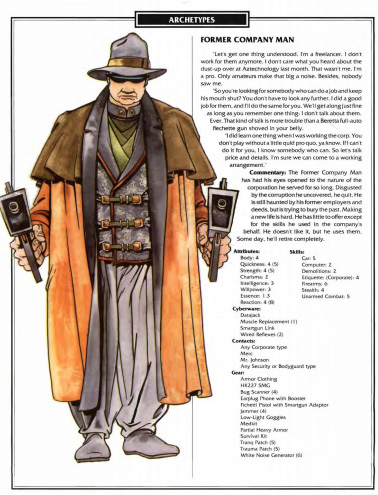
Shadowrun 1st Edition Archetypes: The Company Man
I have been playing some more first edition Shadowrun recently with my two eldest. The game uses 'Archetypes' quite extensively, both for player characters and non-player characters with the idea that because generating characters in Shadowrun can take a while (mainly from how long it can take to buy equipment rather than the rest of the Chargen system), the game should have plenty of pre-packed characters for both players and GM to use out of the proverbial box.
![]() |
I don't think it is any secret that the characters were not even lightly min-maxxed but that is not my point in this post. As far as I can tell, one character is short-changed incredibly badly on the low-side for reasons that I can't understand or even guess at, at a more profound level than 'did someone mess this one up?'. That character is the "Former Company Man".
Shadowrun 1st edition uses a priority system for character generation, with 'Skills', 'Attributes', 'Equipment/Resources/Spells', 'being Magical' and 'being Metahuman' ordered from most important to least important, with the idea being that characters who rely on equipment will get 1,000,000 'NuYen' to spend, but characters who rely more on their personal skills or magic will get far less. But what seems to have happened with the 'Former Company Man' archetype is that it was intended that his skills should have been the top priority - and got 40 skill points - but instead was only given 28. His second priority looks like it should have been resources; he was entitled to 400000 NY and his gear adds up to c.222,375, which is fine, and was given 200000 NT additionally, which was obviously rounded to his advantage, but is broadly correct. His basic attribute total 20, which is correct for having Attributes as third priority. So, in the book, his stats are:
Former Company Man
(Skills 4/28(40), Attributes 2/20, Equipment 3 400,000/50)
Attributes:
|
B |
Q |
S |
C |
I |
W |
E |
M |
R |
|
4 |
4 (5) |
4 (5) |
2 |
3 |
3 |
1.3 |
- |
4 (8) |
Skills: Car 5, Computer 2, Demolitions 2, Etiquette (Corporate) 4, Firearms 6, Stealth 4, Unarmed Combat 5
Cyber-ware: Data-jack, Wired Reflexes 2, Muscle Replacement 1, Smartgun Link
Gear: Armour Clothing (6/4/14), Bug Scanner (4), Earplug Phone with Booster, Jammer (4), Low-light Goggles, Medkit, Partial Heavy Armour, Survival Kit, Tranq Patch (5), Trauma Patch (5), White Noise Generator (6), 200,000Y, HK227 SMG, Fichetti Pistol
|
Name |
Type |
Concealability |
Ammo |
Damage |
Weight |
|
HK227 SMG |
SMG |
4 |
20(Clip) |
5M3 |
4 |
|
Fichetti Pistol with Smartgun Adaptor |
Light |
6/7 |
10/22(Clip) |
3M2 |
2 |
Contacts (choose 2): Any Corporate type, Merc, Mr. Johnson, Any Security or Bodyguard type
Like many of these archetypes, doing an entirely new build would be best, but as a quick patch for it, I have made some changes below. I haven't allowed myself to reduce any of his skills, but will increase/purchase new skills as necessary.
Skills: Car 5, Computer 2, Demolitions 6, Etiquette (Corporate) 4, Firearms 6, Interrogation 6, Stealth 6, Unarmed Combat 5
Gear: The HK227 SMG and Fichetti pistol should both be the smartgun versions. He should also have a car and some ammunition (!). That takes his 'spend' up to NY 242,975, leaving him 157,025 in reserve.
1.1.1 Former Company Man (Revised)
(Skills 4/40(40), Attributes 2/20, Equipment 3 400,000/50)
Attributes:
|
B |
Q |
S |
C |
I |
W |
E |
M |
R |
|
4 |
4 (5) |
4 (5) |
2 |
3 |
3 |
1.3 |
- |
4 (8) |
Skills: Car 5, Computer 2, Demolitions 6, Etiquette (Corporate) 4, Firearms 6, Interrogation 6, Stealth 6, Unarmed Combat 5,
Cyber-ware: Data-jack, Wired Reflexes 2, Muscle Replacement 1, Smartgun Link
Gear: Armour Clothing (6/4/14), Bug Scanner (4), Earplug Phone with Booster, Jammer (4), Low-light Goggles, Medkit, Partial Heavy Armour, Survival Kit, Tranq Patch (5), Trauma Patch (5), White Noise Generator (6), 200,000Y, HK227 SMG Smartgun w/7 full mags, Fichetti Security 500 Smartgun w/6 full mags
|
Name |
Type |
Concealability |
Ammo |
Damage |
Weight |
|
HK227 SMG |
SMG |
4 |
20(Clip) |
5M3 |
4.5 |
|
Fichetti Security 500 |
Light |
6/7 |
10/22(Clip) |
3M2 |
1.5 |
Contacts (choose 2): Any Corporate type, Merc, Mr. Johnson, Any Security or Bodyguard type
|
Cars |
Handling |
Speed |
Body |
Armour |
Signature |
Pilot |
Cost |
|
Ford Americar |
4 |
40/120 |
2 |
0 |
2 |
2 |
20000 |
:strip_icc()/pic569266.jpg)
:strip_icc()/pic541072.jpg)
:strip_icc()/pic526825.jpg)
:strip_icc()/pic632710.jpg)